
Time Traveling
This week's newsletter features a bus trip between scam and kindness, a time travelogue back to misspent youth (so fun!), and a poem that takes us into the heart of the broken world (and back again).

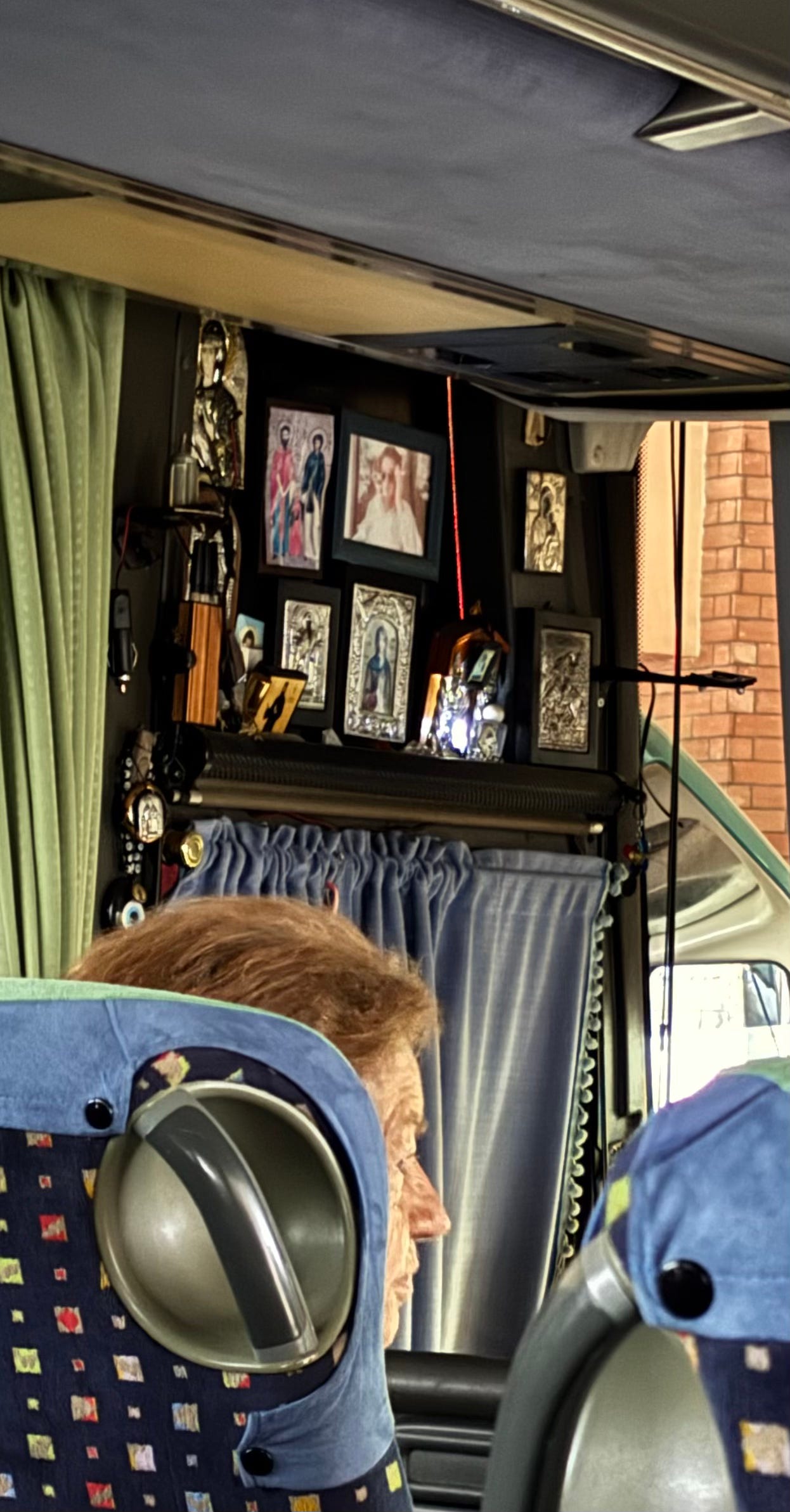
Get on the bus.
If, when you come to Greece, you want a meandering journey through the small dramas of everyday life, then by all means, go by bus.
That’s what I did when I lost my passport and had to visit the US embassy in Athens to arrange a replacement. My husband and I took the local bus to Kalamata, a twisty hour north through small villages, then the Kalamata-Athens ride. And back again to come home.
In a country with a (largely unjustified) reputation for laxity, the bus represents pinpoint precision. Busses always leaves on time. Not nearly or just about. On the dot. And they are incredibly well organized. There are guys who stash the luggage like Tetris pros. A guy who checks your ticket as you board, and another who rechecks it enroute.
The busses are festooned with shrines to the driver’s favorite saints, photos of their loved ones, or even teddy bears. And they’re clean. In this country where smoking is a national pastime, no one dares to light up on board. Seats are assigned on the long haul rides, but if disputes arise, the driver’s assistant steps in, the ultimate authority.
The bus station in Athens is a world unto itself, with competing café/snack shops, book sellers, and a spotless pay-as-you-go toilet. Then there are the scammers. Two “nuns” dressed in black habits cruise the station like wallet seeking drones. One will thrust a rosary or wooden cross at you, even drop it in your lap if you’re sitting, then demand payment. I fell for it once and still have the crucifix in my desk. Who knows – maybe it’s blessed? But as the internet confirms, they are not real nuns. They are part of a network roaming the station, creating diversion so that pickpockets can ply their trade.
So it was with this keep-away mindset that I waited for the second bus, the local from Kalamata. It was market day, and several women were taking back their haul: bags of beets, potatoes, greens. A young man came up to me, smiled, wanted to shake my hand. But, still in scam-alert mode, I shunned him. He touched my shoulder anyway.
Then I noticed he was doing the same to everyone. His nearby mother, one of the ladies with market goodies, kept a gentle eye on him. He meant no harm. Maybe a little off, but clearly not trying to steal. Quite the opposite. He wanted to give.
No scam. Just kindness.
XO Jean

Follies of youth, New Orleans edition.
Leah Mueller was a polite midwesterner when she moved to New Orleans. Whether fending off an “ankle lover” in the French Quarter, getting stiffed by drunken cheapskates while waitressing at Houlihan’s, or ditching her philosophy class to hear a mediocre poet read (then saving herself from his clutches by espousing admiration for Bob Seger), her tales of the Big Easy will make you laugh.
And who knows. They might just remind you of your own misspent/well spent youth.
From the Vault
“The question that motivates me is this: What’s possible? Given my strengths and weaknesses, given my history and inclinations, what can I do with my one and only glorious body?”
Jean Shields Fleming, On My Knee

Languid as a flower.
In Elizabeth Burk’s beautiful poem, “The End of the World“, she offers human connection as a remedy for enduring the violence of the world.