
Lessons in Resilience
In the wake of Jane Goodall's passing, we need new beacons of hope. Katerina Mikula comes through in this heartfelt reflection on what it means to love a place, lose it, then discover its new life.

What happens when you have a deep heart connection to a place and then that connection is suddenly cut off? The grief might cut like a knife. If you are very young, you compartmentalize, lock it away, and adapt as quickly as possible. Later in life, it feels visceral and omnipresent.
I experienced my first loss of a place when I was ten years old. It was 1985 and my family fled an authoritarian regime in Eastern Europe for a better life and opportunity in California. My parents did not tell me we were not coming home until we were already gone “on vacation”. I didn’t get to say good-bye to my friends, pack my favorite things, or wrap my head around the impending change. Most crucially, though, I lost access to the land. Although we lived in a city, we spent every weekend and summer in a remote mountain farmhouse that my parents purchased and refurbished when they first married. No electricity? Kerosene lamps and a giant wood burning stove took care of that. No running water? A pump and well in the backyard provided all the fresh water we would ever need. There were no paved roads. To get supplies, the nearest store was an hour’s hike down the mountain. To me, it was a magical paradise of expansive meadows and fragrant forests. I was a princess, I was a Wild West heroine, I was a marathon runner, I was free. But in short order, I was to trade it all for the real-world Wild West: strip malls and parking lots of a place that would soon become the heart of Silicon Valley. I compartmentalized. I adapted. I forgot my grief. I grew up.
Some fifteen years later, I moved to Oregon and I finally felt myself exhale. The mountains, the magnificent trees, the vast incredible forests - my heart at last remembered what it had stored away for decades. Over time, I explored countless beautiful places in my new home state. In 2010, I heard about Opal Creek Ancient Forest Center and immediately understood it to be a gem of gems, an emerald wonderland. Opal Creek and the surrounding wilderness is a remote temperate rainforest in Oregon’s Western Cascades at the confluence of creeks that form the headwaters of Little North Santiam River. Imagine: towering thousand-year-old trees surrounded by mountain peaks, ferns lining the soft greenlit forest floor, and the most gorgeous water flowing through it all, sometimes bounding over rocks as waterfalls and other times resting at inviting swimming holes, catching all the hues of deep blue, green, gold, and in between.
Opal Creek also has a special history. The land was traditionally inhabited by indigenous tribes of Western Oregon. In 1855, the Santiam bands of the Molalla and Kalapuya people participated in the negotiation and signing of the Willamette Valley Treaty, whereby over 15 Indigenous groups ceded the majority of their aboriginal lands to the United States in exchange for a permanent reservation, annuities, supplies, educational instruction, vocational training, health services, and protection from violence by American settlers[1]. Around 1859, miners began to explore the valley, having discovered gold, silver, zinc, lead, copper, and other precious metals. Relics of mining activity can still be seen in the area today, most notably in Jawbone Flats, a camp town that served as a mining base. In 1933, the area became part of the Willamette National Forest and small-scale mining was allowed to continue. Toward the end of the 20th century, in an ironic twist of fate, the Shiny Rock Mining Company consolidated mining claims, ceased mining operations, and its affiliates launched a decades-long, ultimately successful conservation movement that prevented the U.S. Forest Service from logging the area’s forests. In 1996, Opal Creek was designated by Congress as a protected wilderness and scenic recreation area. From 1996 to 2020, Opal Creek Ancient Forest Center served as an educational nonprofit focused on forest ecology and conservation. Each year, the organization brought thousands of school children to the area for outdoor programs and backpacking expeditions.


I visited as often as I could and shared the magic with friends and family. Countless times, we drove the winding bumpy road up the mountain to the trailhead, then hiked three miles through the old growth forest to Jawbone Flats, stopping at waterfalls and swimming holes. I introduced my daughter to backpacking here and made it a tradition every summer to sleep among the giant trees. The trees spoke to us! Each visit, they would transmit unique insights that I would scribble in tiny notebooks. Every time, I came away with immense gratitude for having finally found this place. I took comfort in knowing that no matter what was happening in my life, I could always come back here to reset and restore. In 2015 when I turned 40, I rented one of the cabins in Jawbone Flats and brought a group of family and friends together for two nights. We hiked and enjoyed swimming in the icy waters. We learned about the center’s history and its focus on conservation. A fun throwback to my off-the-grid childhood days: the cabin’s electricity was generated by a Pelton wheel that took in water from a nearby rushing creek to create power for all of Jawbone Flats.
I must have intuitively known to hang on to every moment and every detail, as if I was on borrowed time. In 2020, I was cut off from all of it. This time, there was no compartmentalization, no adapting. Just pure grief. I cried for days, weeks, months.
The Beachie Creek Fire started in mid August with an unassuming low grade smolder caused by lightning two miles from Jawbone Flats. The area is so remote that fire crews could not safely access it by land and instead managed it as much as possible from air. But on September 7, 2020, winds picked up to speeds of 50-75 miles per hour, igniting the blaze into a full-blown inferno. It moved quickly and obliterated the forest canopy at an estimated 2.77 acres per second.[2] The fire blasted through the canyon so fast that communities in lower parts of the valley had little to no warning. Tragically, five lives were lost and among them was George Atiyeh, the renown environmentalist who played a pivotal role in leading the conservation campaign in the 1980s and 90s that resulted in Opal Creek’s protected designation[3].
Science says that wildfires are part of a natural cycle - forests routinely burn every few centuries. And it can also be said, with much evidence, that climate change creates certain conditions, thus impacting the frequency, intensity and speed of wildfires. Maybe this fire would have happened eventually, but maybe not in our lifetime.
At first, it was hard to understand what, if any, of the area still remained. Access was all but impossible. Over time, Opal Creek staff dropped in via helicopter and shared dispatches with the public. 25 of 28 structures at Jawbone Flats were gone. Much of the old growth forest was gone. Imagining the future of Opal Creek seemed many years away.


This past summer marked the fifth year since the fire. The area and access road to the trailhead are still closed to the public. But for the first time, the organization began taking groups of ten at a time on guided hikes to Jawbone Flats to spend a night in the lone cabin that miraculously survived the fire. I was lucky to get a spot and joined a group of hard hat-wearing hikers through the burn zone, guided by the center’s executive director and staff members. We were an eclectic group from various walks of life - an architect, two obstetricians, a midwife, a marketing executive, a university program director. Some of us couldn’t stop talking while others hung back in silence and reflection. But the one thing we all had in common was a shared love and loss of place. Unprepared for what we were about to see, we reflected as a group on our openness and curiosity to discover what this new landscape could mean to each of us.
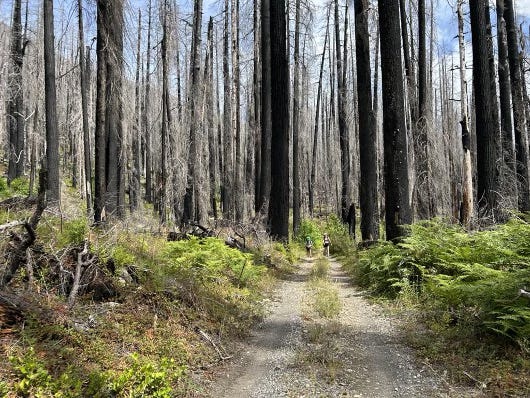
My heart sank as I learned that the old growth forest we walked through experienced 100% mortality. It was like visiting an enormous, beautiful graveyard. The trees, mostly still standing, were charred and no longer alive. On the other side of the creek, trees were blasted like horizontal matchsticks, laying in one direction. Parts of the trail were totally unrecognizable. Jawbone Flats had humongous piles of scrap metal – the remnants of burned structures – waiting to be airlifted out. And Opal Pool, the crown jewel, resembled a pummeled moonscape. How to reconcile the memories of the past with this new reality?
Over the course of the weekend, we not only saw what was lost but also learned what has already changed. Evidence of resilience and regrowth was everywhere, from the lush green forest floor brimming with bright pink fireweed, berries, and maple saplings, to new generations of Douglas fir, hemlock, and red cedar. Birds and wildlife are now thriving in the area, with trail cameras frequently observing cougars and bears. The organization is actively taking steps to reimagine the future of Jawbone Flats. They’ve invited architects to propose plans and have also established a partnership with the Confederated Tribes of Grande Ronde to ensure a sustainable stewardship of the land for generations to come.
The next morning before the hike out, I stood at the confluence of Opal and Battleax creeks which form the headwaters of the Little North Santiam River. I looked up and saw that I was standing in a grove of live Douglas fir. These trees survived! I looked at the water and realized that it is still the same beautiful water, ever-flowing, like hope.
On the hike out I reflected on my own resilience and how this forest, even after the fire, continues to teach me to keep growing, changing, rising. In the decade since I spent my 40th birthday at Opal Creek, of the people who were there with me then, I lost my father to cancer and a friend to a sudden cruel illness. My married life transitioned to life after divorce. There was a global pandemic. Climate change continues to ravage our planet, destroying treasured places and lives. And now, the same authoritarian forces that my family fled during my childhood are once again knocking at our doors. The future is unclear. Subsequent firestorms and shitstorms are imminent – that much is all but certain.
But I am 50 now and I believe I have enough confidence, wisdom, and capacity to calmly face whatever might lie ahead. Instead of despair, I want to be able to reimagine my life in the spirit of steady regrowth and resilience, like Opal Creek.
Before arriving back at the trailhead, our group stopped at a swimming hole. One by one, we each braved it and got in. We took in the scene one last time. The water is warmer now. Among the charred trees, there is still beauty everywhere. The place is profoundly changed but it is not lost and it is ever-changing still. As we piled into the utility van at the trailhead and began the drive down the mountain, a black bear bounded across the deserted road. Our van slowed to let the bear safely pass. We all shrieked in delight.
[1] OpalCreek.org Jawbone Flats History
[2] The Oregonian; Can Opal Creek, a treasured natural area devastated by the 2020 Labor Day wildfires, come back to life?; September 1, 2025
[3] Statesman Journal: George Atiyeh, icon who saved Opal Creek and changed Oregon, confirmed dead in Beachie Creek Fire; September 25, 2020
Katerina Mikula lives near Portland, Oregon and works in K-12 education. She makes it a daily habit to find a slice of forest somehow, somewhere. She continues to support Opal Creek Ancient Forest Center as it evolves into its next beautiful iteration.
Images of Opal Creek, before and after the fire, courtesy of Katerina Mikula.
If this piece resonated with you, please like, comment, or share it. Thank you!
 |
|
I have goosebumps after reading this beautiful, precisely-realized, and wonderful piece. We talk about writings being "inspiring"...for me, this deeply was. Appreciating how resilient we are is important. Thank you.
I treasure the hope you ended with